Quick Summary: The Architecture of a Story Idea
Ideas are not concepts: A concept is a setting; an idea is a conflict.
Iterative Curiosity: Great hooks are found at the third level of the “What If” method.
The Muscle Metaphor: Discipline produces more inspiration than waiting ever will
Where Do Good Story Ideas Come From?
At this point, we’re probably all familiar with the same fairy tale about creativity: You’re sitting in a quiet corner of a library, staring dreamily out the window, and suddenly—BAM—the Muse descends in a fluffy cloud of brilliance. The lightning bolt of inspiration hits, and you then spend the next six hours typing a masterpiece while your coffee grows cold.
It’s a beautiful image. But, alas, it’s also a beautiful piece of fiction.
If you’re waiting for a lightning bolt to strike before you start your next project, you’re mostly just going to get wet standing in the rain. Good storytelling comes from so much more than merely a random jolt of lightening.
In honor of our World Storytelling Week celebration, we’re pulling back the curtain to show you where those “big ideas” are actually hiding.
1. Why Conflict is the Only True Source of Story Ideas
The most common mistake writers make during the brainstorming phase is confusing a setting or a character with a story.
Writer A might say: “I have a great book idea! It’s about colony on Mars and everyone lives in glass domes like greenhouses and use super-powered space golf carts to get around!”
That’s a cool setting. But the story needs more, doesn’t it? All I know is the location and the housing/transport situation. That could just as easily be a travel brochure or a flyer about retirement housing on Mars. We need conflict.
Writer B might say: “My idea is about a cynical detective who hates the rain and has been divorced twice.”
Again, that’s an intriguing character sketch. We might have some lingering questions about this detective, but the details shared don’t give us plot. We need more.
Great story ideas come from friction.
A story doesn’t truly begin until you break something. If you’re feeling stuck, stop trying to be poetic or lyrical and start being a little mean to your characters. (Seriously!) Take a person who wants something desperately, and then drop the one thing they’re afraid of right in their path. See what happens.
The “But” Test
To stress-test your concept, apply the “But” test. If your premise can’t support a “but,” it can’t likely cannot support a 300-page novel.
The Flat Premise: An elderly woman spends her retirement tending to her prize-winning roses. (Sweet, but a bit sleepy, right?)
The Conflict-Driven Idea: An elderly woman spends her retirement tending to her prize-winning roses, BUT she discovers a body buried under the prize bush, and the shovel belongs to her favorite grandson.
Now, we’ve got something. We have a setting and a problem. And problems are what keep readers turning pages at 2:00 AM.
2. The “What If?” Rabbit Hole
The “What If?” method is a staple of creative writing. It tells you to take your idea and ask “What If?” to build it out further. What is shared less often is the fact that there is a trick to this.
Don’t stop at the first answer. Keep asking!
If you’re exploring your idea using the “What If?” method, the first answer is usually a cliché you saw in a movie once. The second answer could be a trope or a theme. The third or fourth answer? That’s where your original voice lives. That’s the stuff that feeds story.
Don’t believe me? Let’s try it! We need a mundane, frustrating moment to unravel.
Moment: Stuck in the middle seat on a Trans-Atlantic flight.
Let’s pull on some threads to see how we can unravel this into a story!
Level 1 (The Surface): What if the person next to me in 14C is a secret billionaire? (A little “rom-com,” let’s keep going.)
Level 2 (The Twist): What if the person next to me is fleeing a high-profile scandal and that’s why they keep frantically refreshing a news site? (Intriguing, but we need to dig deeper.)
Level 3 (The Hook): What if when the person in 14C gets up to use the restroom, their phone buzzes and you see your full name and address pop up on the screen? (Ok, now we have the beginnings of a story!)
Don’t settle for the easy “What If.” Go three layers deep and give yourself permission to get weird. This is how you bring fresh, new ideas to your storytelling.
3. Mining the “Boring” Moments
You don’t need to hike the PCT or travel to the Arctic to find inspiration. You just need to pay attention to the cracks in the sidewalk. Most iconic character quirks come from Active Observation. Maybe there’s a weird turn of phrase a stranger yelled into their phone at the grocery store, or you observe the specific, obsessive way your neighbor mows their lawn. All of this is fodder for your storytelling.
Document it and use it. Keep a notebook with you or open up your Notes app to record observations. The world around us is overflowing with story if we only take the time to look.
The Emotional Transplant
Your life is also a goldmine for story ideas, but not in the way you might think. You don’t need to write your memoirs or put your trauma on the page in order to use it. Instead, think about the emotions you’ve felt over the course of your life.
The vertigo + butterflies feeling of falling in love for the first time.
The pit-in-your-stomach creeping dread of walking into a haunted house.
The pure, unadulterated joy when your dog greets you at the end of a hard day.
These raw feelings are your story fuel. You can take the emotion and transplant it into a world that looks nothing like your own.
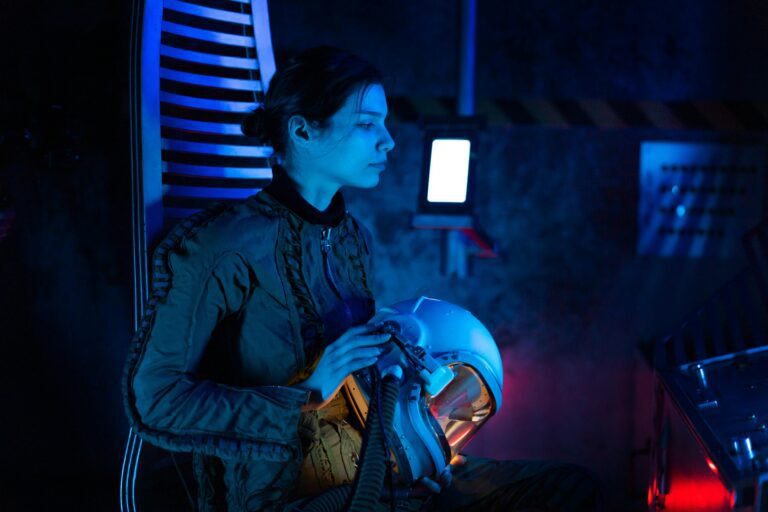
The Dead-End Job: If you’ve ever felt the suffocating, soul-crushing boredom of a 9-to-5 cubicle, don’t write about spreadsheets. Write a sci-fi thriller about a mechanic on an abandoned underwater station who knows the oxygen is running out, but can’t get anyone to listen to the data.
The Heartbreak: If you’ve ever sat in a parked car and felt your heart physically ache after a breakup, don’t just write a diary entry. Write a contemporary YA novel about a kid who has to move across the country and leave behind the only person who ever truly “got” them.
Authentic emotion is what makes a high-concept idea feel relatable to your readers. You can have the highest-concept, most “out there” premise in the world, but it will only feel real to your readers if the character’s dread or joy feels like something they’ve tasted before.
4. Writing is a Muscle, Not a Mood
Here is the part most of us try to avoid: Writing is a muscle, and muscles don’t care if you’re in the mood to train. If you only hit the gym on the days you felt 100% inspired to lift, you’d never actually get stronger. Your craft works the exact same way.
Waiting for the perfect idea isn’t being a perfectionist—it’s just a sophisticated way of procrastinating. We’ve all seen a mediocre premise get turned into a masterpiece through the sheer, stubborn force of a first draft. Meanwhile, how many genius ideas have died in a desk drawer because the writer was too afraid to start until they felt ready?
The truth is: You aren’t ready until you’re typing.
Inspiration follows action. If an idea is 60% there, that’s your cue to start. Don’t wait for the full 100%. You’ll find the missing 40%—the subplots you didn’t see coming and the deep thematic resonance—while you’re actually in the trenches doing the work.
You can’t steer a parked car, and you definitely can’t edit a blank page. Stop waiting for the lightning bolt and just start the engine.
FAQ: Frequently Asked Questions About Story Ideas
How do I know if my story idea is “good enough”?
A good idea is one that you can’t stop thinking about. But more technically, a strong idea has “legs”—meaning you can see at least three different directions the conflict could go. If you can’t imagine a climax, your conflict isn’t strong enough yet.
What should I do if I have too many ideas?
Pick the one that makes you the most uncomfortable. The ideas that scare us or make us feel a little vulnerable usually have the most “truth” to them, and that truth is what resonates with readers.
Does AutoCrit help with the brainstorming phase?
While AutoCrit is famous for its world-class editing tools, it’s also a powerful brainstorming partner. You can use our Story Builder with Alpha Reader and Market Fuel tools to brainstorm and workshop your ideas to confirm you have enough to sustain a full-length novel before you spend months writing it!
Need a productivity boost? Registration is now open for the Summer 2026 Novel 90 Writing Challenge. This free writing challenge consists of 90 days of structure, encouragement, and supported by bestselling author coaches.
Come see why thousands of authors have met their writing goals using Novel 90! We hope to see you there!