Story thrives on structure. For centuries, philosophers and storytellers have sought to distill the essence of satisfying narratives shared by humans since time immemorial—from story structures such as Freytag’s Pyramid, to The Hero’s Journey and beyond.
As a modern adaptation of The Hero’s Journey, Dan Harmon’s Story Circle proves an extremely effective tool predicated on universal story structures. While both frameworks aim to guide characters through transformative journeys, Harmon’s method simplifies the process, leaving plenty of creative freedom available to the writer.
In this guide, we’ll explore each stage of Dan Harmon’s Story Circle, compare it to the traditional Hero’s Journey, and decide whether it might be the right choice of framework for you.
Who Is Dan Harmon?
Born in Milwaukee, Wisconsin, in 1973, Harmon’s journey to becoming a influential figure in television began in the world of alternative comedy. He co-founded Channel 101, a monthly short film festival in Los Angeles that became an early platform for experimental digital content and helped launch several careers in comedy.
After co-writing 2007’s critically-acclaimed (and Oscar-nominated) animated film Monster House, Harmon created Community, a comedy series about a study group at a community college. The show became known for its pop culture references, meta humor, and weird, experimental episodes that played around with different TV and movie genres, and while never a huge ratings hit, it managed to draw a highly dedicated fanbase.
Later, Harmon teamed up with co-creator Justin Roiland to make Rick and Morty—an animated show about a genius scientist and his grandson going on sci-fi adventures—which would go on to become a global phenomenon.
The Essence of Dan Harmon’s Story Circle
The Dan Harmon Story Circle is a narrative structure born out of Harmon’s desire to create a more accessible version of the classics. Drawing from the 12 steps of Joseph Campbell’s Hero’s Journey (itself explored by Christopher Vogler in his book The Writer’s Journey: Mythic Structure for Writers), Harmon developed his own storytelling framework which he has used throughout his career.
The beauty of the story circle lies in its adaptability across genres and formats, offering a blueprint that can be personalized to fit the unique vision of the storyteller. Whether you’re writing a screenplay, a novel, or a short story, Harmon’s method provides a foundational skeleton on which to build your narrative while ensuring that each step of the character’s journey is both purposeful and impactful.
Where Campbell’s Hero’s Journey condensed a complete narrative arc into 12 steps, Harmon’s Story Circle pulls it back to 8—a series of foundational narrative “beats” that guide characters along a path of challenges and growth. This puts it among some of the most versatile story structures, with the steps of the story painted in broader strokes. Being a circle, Harmon’s approach leans into the cyclical nature of life itself, just as Campbell does. Once one journey is complete, it merely sets the stage for the next one—a new status quo has been formed, ready to be challenged once again. This is, naturally, quite ideal for serialized television!
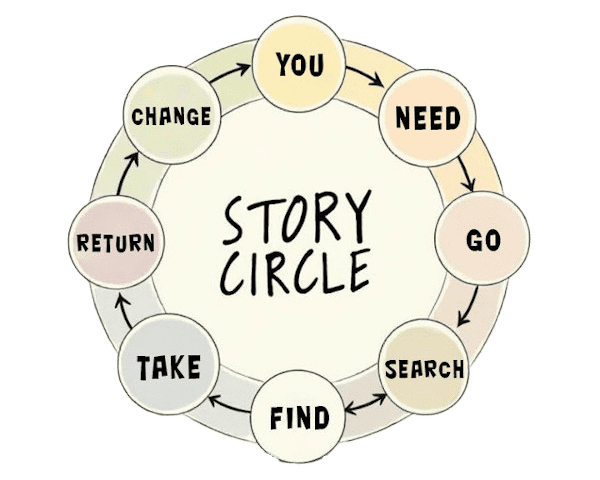
The 8 Steps of Dan Harmon’s Story Circle
In a nutshell, the Story Circle lays out a story’s progress in these 8 essential steps:
You (Establish a character in their comfort zone.)
Need (The character wants something.)
Go (The character enters an unfamiliar situation.)
Search (The character adapts to the new situation.)
Find (The character gets what they wanted.)
Take (The character pays a price.)
Return (The character returns to their familiar situation.)
Change (The character is transformed.)
Each step is designed to build upon the last, creating a seamless narrative arc that’s both thrilling and emotional, and leans heavily into the personal effects of the journey on the central character(s). Let’s examine each step in detail.
Step 1: You – The Comfort Zone
Every story begins with a status quo, where characters exist in their normal world, untouched by the adventures to come. This initial step establishes the protagonist’s starting point, introducing the audience to them in the “natural habitat” or zone of comfort, and providing a baseline for their personal and emotional state.
Establishing a strong starting point is essential for readers to connect with the character, since a well-drawn initial state creates a contrast with the changes that follow, meaning the stakes of the journey are clear.
In the Hero’s Journey, this step corresponds to the “Ordinary World,” where the hero’s normal life is depicted before they receive a call to adventure.
Step 2: Need – The Desire
In this phase, a desire or need arises within the protagonist, prompting them to seek something beyond their current existence. This need drives the narrative forward, pushing the protagonist to depart from the comfort of the ordinary world. Whether it’s the pursuit of love, power, knowledge, or redemption, it’s the spark that ignites the story—what we would label the “Call to Adventure” in the Hero’s Journey or the Inciting Incident in other modern frameworks.
The Story Circle, however, places a stronger emphasis on the character’s internal motivation as the catalyst, rather than having an external inciting incident prompt the journey.
Step 3: Go – Into the Unknown
Armed with a desire to fulfill their need, the protagonist leaves their comfortable world and ventures into the unknown.
This step parallels the “Crossing the Threshold” phase of the Hero’s Journey, where the hero commits to their quest and leaves their old world behind—sometimes a literal crossing of the threshold of one world into another. Thus, their growth begins as the narrative kicks into gear and establishes the central conflict. This is also the phase of the story where we’ll start to see the protagonist’s strengths and weaknesses, as we get to know them in a more pressurized environment.
Step 4: Search – Trial and Adaptation
As the protagonist delves deeper into the unknown, they encounter a series of trials that test their resolve and ability to adapt. It is through these challenges that the protagonist begins to grow, developing new skills and insights that will aid them on their journey. Here, they’ll engage with their new environment(s), make allies and enemies, face moral dilemmas, and discover what they’re truly made of.
This stage aligns with the “Tests, Allies, and Enemies” phase of the Hero’s Journey, with both frameworks focusing on character development through trials and relationships.
Step 5: Find – The Crucial Discovery
The character achieves their goal or obtains what they were seeking. This victory, however, often comes with unforeseen consequences—such as a hidden truth revealed, or a newfound power discovered. Whatever its form, an unexpected revelation comes alongside this moment of triumph, offering new understanding of what had been previously established and thrusting the story further forward.
This step corresponds to the “Reward (Seizing the Sword)” phase of the Hero’s Journey. In both frameworks, the protagonist reaches a significant milestone… but the story is far from over as the next phase looms: dealing with the consequences.
Step 6: Take – The Price of Achievement
The protagonist must confront the consequences of their journey. This can be a personal sacrifice, a loss, or an internal reckoning as they come to terms with the costs of their desires. The narrative tension peaks, as the character grapples with the emotional weight of their decisions and their impact on their world. Here, we cement the core of the protagonist’s transformation by showing how they react to paying this cost.
This step aligns with the “The Road Back” and “Resurrection” phases of the Hero’s Journey.
Step 7: Return – The Journey Back
With their mission accomplished and lessons learned, the protagonist embarks on the journey back home. The flight home isn’t straightfoward, though, as the protagonist must navigate some final hurdles before their transformation is complete.
At this stage of the Story Circle, we’ll begin to see how the character’s return isn’t truly a conclusion, but a new beginning. Their identity, their worldview, perhaps even their world itself, are fundamentally changed in some way—and we know they’ll have to deal with that, one way or another.
This step mirrors the “Return with the Elixir” phase of the Hero’s Journey, where the hero brings back knowledge or a boon to their community.
Step 8: Change – The Character’s Evolution
The final step in the story circle is the highlighting of the character’s evolution—a final coda that definitively marks “then versus now” once the protagonist returns.
For some characters, like Harry Potter returning to his aunt and uncle’s home, it’s a chance to see their old world through new eyes and find a level of acceptance that they couldn’t before. The character’s evolution, their emotional arc, is the essence of the Story Circle—and here, in the end, we display a resolution that is both cathartic and reflective.
Practical Tips for Using the Story Circle
Start with the Character’s Need – Identify what your character wants and why it matters. Ensure their need is compelling enough to drive the entire story.
Map Out Each Step Before Writing – Use the Story Circle as a planning tool. Sketch out each of the eight steps before you begin writing to ensure a clear narrative arc.
Focus on Consequences – Make sure that each step has tangible consequences for the character. For example, when they take a risk or pay a price, it should impact their choices moving forward.
Anchor Emotional Beats in Every Phase – Each phase of the Story Circle should evoke an emotional response from the audience. Whether it’s hope, fear, or triumph, ensure your narrative is packed with meaningful, emotional heft.
Iterate and Refine – Don’t be afraid to revise your story. After your first draft, revisit the Story Circle and adjust the narrative to strengthen each phase.
Use It as a Diagnostic Tool – If you feel your story is losing momentum, check which step of the Story Circle you’re on. Are you missing a crucial transition? Has your character’s need evolved?
Think Beyond the Protagonist – Apply the Story Circle to subplots and secondary characters. Their arcs should also follow a trajectory of change, as much as possible.
Ensure Transformation is Earned – The final change must feel authentic. Ensure your character’s transformation results from the emotional journey they’ve been on, not from purely external circumstances or completely out of the blue.
Examples: The Dan Harmon Story Circle in Action
Understanding the Story Circle becomes clearer when analyzing its application in popular stories and even your favorite movies. Many beloved films, novels, and TV shows follow this narrative structure closely. Whatever the genre, you can watch as protagonists begin in familiar situations before they desire something more, face challenges, and emerge changed in the end.
Let’s take a look at a few examples of the Story Circle at work.
Movies: While You Were Sleeping
This classic romantic comedy exemplifies the Story Circle. Lucy’s journey starts in her comfort zone, working at a ticket booth. Her life takes a dramatic turn at the train station when she rescues a man from an oncoming train. As she’s mistaken for the fiancée of the comatose man, Lucy plays along before finding herself drawn to his brother, Jack.
The narrative hits all eight steps as Lucy’s lie leads her to explore new relationships and confront her loneliness, culminating in finding love with Jack. The emotional stakes reach the highest point when Lucy reveals her deception at the wedding and then retreats, assuming (internally) that the cost of the lie is that Jack will reject her fully. That isn’t to be, however, as the story comes full circle with Jack proposing. Lucy marries Jack and gains the love she was always looking for, giving us a happy romantic ending.
Movies: Taken
Taken showcases the Story Circle through the intense journey of Bryan Mills, a retired government operative. We begin with Bryan in his familiar life, struggling to connect with his daughter. His world is upended when she’s kidnapped, blasting him headlong into a quest to rescue her (quite literally the “Go” and “Search” steps of the circle).
As Bryan navigates the underworld to find his daughter, the “Find” and “Take” phases arise through his discoveries and the moral and physical costs of his mission. His return home with his daughter marks the completion of the circle, completing both the literal journey and the internal transformation Bryan undergoes as he reforges their failing relationship.
And to get even punchier, let’s go with the straight 8 steps across a few more…
Movies: The Lion King
You: Simba lives a carefree life as the future king of Pride Rock.
Need: He wants to explore the world beyond his home and prove himself.
Go: Simba runs away after Mufasa’s death and finds himself in a new environment.
Search: He adapts to life with Timon and Pumbaa but feels a void.
Find: Simba learns about Scar’s tyranny and decides to return.
Take: He confronts Scar, risking his life to reclaim his place.
Return: Simba defeats Scar and restores peace to Pride Rock.
Change: He accepts his responsibilities as king.
TV: Breaking Bad
You: Walter White is a high school teacher living a mundane life.
Need: He needs money to provide for his family after his cancer diagnosis.
Go: Walter begins manufacturing illegal substances, entering the criminal world.
Search: He navigates challenges, forms alliances, and confronts deadly enemies.
Find: He gains power and wealth but at a moral cost.
Take: He loses his family and humanity.
Return: Walter returns to his hometown to make amends.
Change: He accepts his fate and dies on his own terms.
Novels: Harry Potter and the Sorcerer’s Stone
You: Harry lives with his aunt and uncle, unaware of his magical heritage.
Need: He wants to belong and learn about his parents.
Go: He enters the wizarding world by attending Hogwarts.
Search: He navigates friendships, classes, and dangers.
Find: He discovers the existence of the Sorcerer’s Stone.
Take: He confronts Voldemort, risking his life.
Return: He returns to the Dursleys for summer break.
Change: He realizes he has a place in the wizarding world.
Short Stories: The Tell-Tale Heart
You: The narrator insists they are sane, living a normal life.
Need: They become obsessed with the old man’s vulture-like eye.
Go: They decide to kill the old man to rid themselves of the eye.
Search: They carefully plan and execute the murder.
Find: The deed is done; they believe they are free of the eye.
Take: Guilt manifests as the sound of a beating heart.
Return: They confront their guilt in familiar surroundings, while speaking with police.
Change: Driven mad, they confess to the crime.
Final Thoughts
Offering simplicity and versatility, Dan Harmon’s Story Circle makes for an excellent storytelling process that any writer can pin on the wall. Whether you’re writing a screenplay, plotting a novel or stacking short stories, this simplified version of the Hero’s Journey is like a fresh cup of coffee among more dense academic frameworks.
As a basic structure, the Story Circle’s 8 steps should serve you well—whether you’re crafting heartwarming romance where the hero finds love, bone-chilling horror with life and death stakes, or cozy adventures to keep the kids entertained. Like any story structure, however, bear in mind that the Story Circle is a starting point, a guide to understanding the core elements of a compelling narrative. True mastery comes from applying these principles while pushing boundaries and exploring new ways to tell your stories.
Keep pushing, keep challenging yourself, and dig ever deeper into the emotions of your characters, conscious and unconscious. When you do, you’ll see all 8 phases explode with dramatic impact.