If you’ve studied creative writing for any length of time, there’s more than a slim possibility you’ve come across Freytag’s Pyramid. Whether shoved in your face by your high school English teacher or casually presented on a creative writing blog just like this one, this pointy little journey (also known as Freytag’s Triangle) remains a fundamental tool for crafting a compelling story.
Pivotal for fiction writers, it breaks the concept of “a story” into manageable segments, guiding its flow from beginning to end with a solid foundation, a defined climax, and a satisfying resolution. In this blog post, we’ll take a look at the makeup of this historic piece of dramatic theory, and explore the ways in which it remains relevant, yet much transformed, when writing a story today.
Origin and Evolution of Freytag’s Technique
Freytag’s Pyramid was—unsurprisingly given its name—developed by Gustav Freytag, a 19th century novelist and playwright. Freytag was particularly enamored with classical Greek and Shakespearean plays, and the essence of plot decreed by Greek philosopher Aristotle’s Unified Plot Structure: “A whole is that which has a beginning, a middle, and an end […] being such that, if any of them is displaced or removed, the whole will be disjointed and disturbed.”
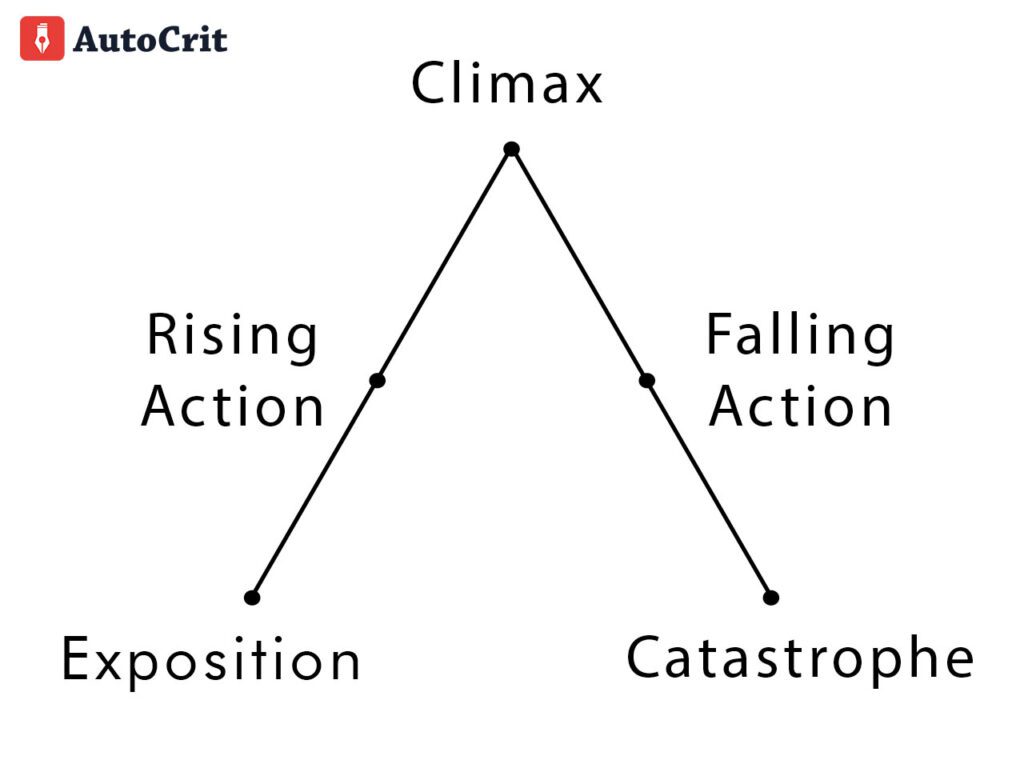
As he sought to codify his own vision of exactly what it was that captured the audience’s attention, and imagination, within the structure of a drama, Freytag settled upon his own five-part framework—outlining the stages of a story, proceeding in a linear progression, that enhances narrative flow. Through a pyramid structure, it begins with exposition, where the scene is set, leading to a series of events that build tension, reach a climax, and then resolve.
At its center, the pyramid emphasizes a climax that arrives at the narrative’s peak—a moment that dramatically changes the story’s direction. This pivotal point, supported by the groundwork laid in the exposition and the tension of the rising action, ensures that stories have a clear arc that audiences can follow, making the resolution all the more satisfying.
Though while the dramatic structure of Freytag’s Pyramid is certainly clear, this technique has evolved beyond its initial scope, adapting to more modern forms of literature and cinema. We’ll take a look at some of those adaptations a little later, but first, let’s look at the core components of Freytag’s Triangle—exposition, rising action, climax falling, and resolution—and why they still remain intact in many modern narratives.
The 5 Stages of Freytag’s Pyramid
1. Exposition: Setting the Stage
The exposition sets the stage for the narrative, as the background, setting, and key characters are introduced. This foundational phase is crucial as it establishes the context that will influence the entire story. Here, the audience gets their first glimpse into the world the characters inhabit, along with initial insights into their lives and motivations.
An important element introduced during the exposition stage is what Freytag calls the “exciting force,” which today we refer to as the “inciting incident” and is the single, impactful event that propels the protagonist into the main action of the story—this could, for example, be the news that the main character’s father has died, sending them on an unexpected journey back home, or when Bilbo Baggins uses the One Ring and then subsequently passes it to Frodo in The Lord of the Rings.
This incident is a catalyst that changes the protagonist’s world and requires them to react, transitioning us from exposition to rising action, as the central conflict of the story begins to come into view.
2. Rising Action: Building Tension
Rising action is marked by escalating conflict and complications that challenge the protagonist and drive the story forward. In this stage of Freytag’s Pyramid, the protagonist moves to achieve their goals, but encounters a series of obstacles that challenge their skills, their will, and their interpersonal relaitionships.
The plot thickens. Characters’ motives become clearer still, adding more layers to what came before (and what we might expect to come next). Interactions between characters become more complex as the tension builds with each challenge, pulling the audience deeper and deeper into the hero’s journey as everything moves towards the climax.
3. Climax: The Turning Point
The climax is the turning point of the narrative—the pivotal moment of highest tension and conflict where the protagonist faces their greatest challenge. It’s the culmination of how the story builds—where the stakes are highest, the outcomes uncertain, and the narrative’s core conflicts are confronted head-on, setting the stage for the story’s resolution.
4. Falling Action: The Reversal of Fortune
Following the climax, where the main conflict has reached its peak, this stage of Freytag’s Pyramid begins the process of unwinding the narrative’s tension through a period of falling action. The consequences of the climax are explored, and the protagonist faces the repercussions of their actions or decisions made at the turning point.
In a conventional story’s falling action period, we’ll begin to tie up loose ends and set the stage for the resolution as the characters’ arcs reach their natural conclusions—perhaps even with the inclusion of a sudden plot twist or two to keep audience investment at a high. This movement allows the story to gracefully approach its final stage, where the narrative’s remaining questions are answered and everything is neatly concluded.
5. Catastrophe: The Resolution/Denouement
Yeah… did we mention that the dramatic structure of Freytag’s Pyramid is based in writing tragedy? It’s true, with his original closing point labeled “catastrophe.”
As Chris Winkle aptly points out in his Mythcreants article, Freytag’s writings seem to refer to “drama” as interchangeable with “tragedy”—a story that ultimately culminates in the hero’s downfall. This is entirely understandable given the theatrical era in which Freytag’s ideas were born, with much of what was presented on stage either steering into tragedy or comedy to please the readers or viewers of the time.
Othello is no more. Macbeth is slain. Romeo & Juliet lie dead together.
In the classical sense, Freytag intends this final, momentous act to be the tragic culmination—the heart-rending curtain-closer after which the cast will bow as an enraptured (and somewhat devastated) audience cheers. After the rising and falling, it all comes to this last punch.
In some explorations of Freytag’s stucture of a drama, however, you may see this portion referred to as the point where all the story’s threads are resolved in the resolution or denouement—the final conclusion. Here, the outcomes of the characters’ journeys are made clear, and the story reaches its natural end.
Elements of Freytag’s Pyramid in Classic and Modern Narratives
Freytag’s Pyramid, though certainly tuned for more classical presentations, has proven its effectiveness by transcending genres and eras, shaping both classic and modern narratives of all kinds. This timeless story structure provides a framework that storytellers have adapted to fit their unique voices and contexts, proving that at the heart of every memorable story is a solid foundation.
While directly mapping it onto more modern narratives does pose some problems (primarily in pacing, which we’ll cover shortly), here are a couple of examples of how, with a little big of leg-wriggling, you might fit more recent works into Freytag’s triangle.
Freytag’s Pyramid and Its Application in “Harry Potter and the Sorcerer’s Stone”
In Harry Potter and the Sorcerer’s Stone, the exposition introduces us to Harry’s miserable life under the stairs at the Dursley home. The exciting force (inciting incident) arrives early on as Harry receives his invitation to Hogwarts—and then as Harry enters the wizarding world, the rising action unfolds through his adventures and challenges, building tension and deepening each conflict of the story.
The climax arrives during Harry’s confrontation with Professor Quirrell and Voldemort, serving as the story’s turning point. This moment embodies the peak of tension and the culmination of Harry’s growth and bravery. Following this, the falling action sees Harry recovering and reflecting on his experiences, leading to a reversal of his previous mundane life. The resolution ties up the narrative threads, with Harry returning to the Dursleys, now armed with the knowledge and friendships he’s gained, setting the stage for future adventures.
Rowling not only crafts a compelling narrative but also demonstrates the simple applicability of Freytag’s Pyramid. Her adept use of this five-part structure ensures a cohesive and engaging story that draws readers into Harry’s world and leaves them eager for more by the end.
Analyzing “The Great Gatsby” Through Freytag’s Pyramid
The Great Gatsby by F. Scott Fitzgerald is a prime example of Freytag’s Pyramid applied in modern American literature. The novel’s exposition sets the scene in the roaring twenties, introducing Nick Carraway and his perception of the enigmatic Jay Gatsby. As the narrative progresses into the rising action, Gatsby’s lavish parties and his pursuit of Daisy Buchanan build tension and complicate the stages of the story.
The climax is reached when Gatsby’s past and his obsession with Daisy lead to a confrontation, revealing the depth of his desires and the illusion of his grandeur. This turning point is critical as it shifts the direction of the story towards the inevitable tragedy. The falling action unfolds with the aftermath of this confrontation, leading to Gatsby’s demise, symbolizing the fall of the American Dream.
The resolution of The Great Gatsby sees Nick left disillusioned, reflecting on the events he’s experienced and Gatsby’s tragic end. Through Fitzgerald’s use of Freytag’s Pyramid, the novel meticulously follows the stages of a tragic story—a clear structure with classic signals that amplify the impact of Gatsby’s rise and fall.
Freytag’s Pyramid Versus Modern Dramatic Structures
The differences between modern dramatic structures and Freytag’s Pyramid are clear at a glance to any experienced writer in the current age—something which leads many to claim Freytag’s postulations as old-fashioned or archaic.
The traditional five-act structure, deeply rooted in the western canon and exemplified in Shakespearean drama, divides a narrative into five distinct parts and allows for a detailed unfolding of the plot and character development.
In contrast, the three-act structure, widely taught in creative writing classes and employed in modern storytelling, simplifies the narrative into beginning, middle, and end for a more concise storytelling model. With its more direct approach to introducing the conflict, building the narrative, and resolving the tension., the three-act structure’s flexibility has made it a favorite among contemporary fiction writers and screenwriters.
Here’s what a more modern-day story structure might look like, instead:

Positioning of the Climax in Freytag’s Pyramid Compared to Modern Story Structure
In Freytag’s Pyramid, the climax is strategically placed at the apex of the structure, signifying the moment when the story’s conflict peaks. As a pivotal moment, the climax for Freytag not only serves as the moment of greatest tension and drama, but as a pivotal turning point for the narrative.
Modern theories of storytelling, however, often position the climax closer to the end of the narrative. This shift in the dramatic arc allows for a prolonged build-up of tension and stakes, aiming to keep the audience hooked until everything can come to a head. This arrangement shortens the time for resolution/denoument, increasing the pace and aiming to let the audience “leave” the story while still feeling the residual impact of the climax—now the story’s biggest, most crowd-pleasing set-piece. Since the “buzz” of the climax is allowed to reverberate across a shorter resolution, the result is a more satisfying overall payoff for the audience.
Remember: we aren’t necessarily ending the story with a final, tragic outcome anymore.
That said, while the positioning of the climax may vary, its role as the story arc’s pivotal event remains undiminished. It’s still the peak of the chart, underscoring the adaptability of Freytag’s principles in both traditional and contemporary storytelling.
Plot Elements: Freytag’s Climactic Turning Point vs. The Modern Midpoint
Where the dramatic structure of Freytag’s Pyramid combines the climax with a major story turn, modern storytellers lean harder into what we would refer to as the “midpoint shift.” This introduces a major narrative turn, a surprising revelation, that appears at roughly the middle of the story and sends the narrative off into new, unexpected territory—even, perhaps, changing the entire goal the characters are striving for.
It could be the result of betrayal as characters’ motives are revealed. It could be an early attempt at solving the core conflict that (perhaps literally) blows up in the protagonist’s face and forces an entirely new approach for the remainder of the story. It’s when the power goes out in Jurassic Park, killing all defenses. It’s when the fleeing heroes are thwarted by an alien attack on their evacuation ship in Aliens.
With a great midpoint, the game changes in a pivotal manner but the tension continues to rise towards a climax that’s set much further ahead, narratively, than Freytag would have conceived.
Commonalities in Rising Action
Speaking of rising tension, Freytag’s intent with incorporating immediate escalation still holds true today. In Freytag’s Pyramid, escalation begins pretty much instantly. His advice, though, is somewhat nebulous—with what he calls the “exciting force” being the equivalent to the modern-day “inciting incident.”
For Freytag, the inciting incident happens amid ALREADY rising action in the story—which is actually perfect, when you come to think of it. In some modern adaptations of Freytag’s Pyramid, flat time is given for opening exposition, or an introduction, during Act 1…
But who has time for flat detail?
Enter the concept of in medias res: start with action already ongoing! Literally meaning “in the middle of things,” starting in medias res is one of the most common pieces of modern writing advice you’ll see—and for good reason. Modern audiences crave excitement, a hook, right from the off. But that doesn’t mean every story needs to begin with an explosion.
Rather, it simply means that we should start our stories with something engaging that’s under way. An argument. The main character sitting in the middle of a boardroom meeting that’s turning heated. A honk-filled traffic jam on a city street while our protagonist, running late for their child’s birthday party, is being berated in the back seat of a taxi while the summer sun beats down.
This “problem in progress” doesn’t need to actually form part of the story’s core conflict, nor does it need to tie directly into the inciting incident, but it at least gives us the sense, as an audience, of instant momentum the moment we enter the world of the story. If your opening problem does tie directly to the core conflict, or is indeed the inciting incident itself, then that’s also great. Storytelling is, after all, incredibly flexible.
Flexibility and Fast Resolution
As you can tell by now, given how Freytag’s Pyramid has been adapted, twisted and tweaked over time, storytelling is nothing if not flexible. As a creative endeavor, approaches can vary wildly even if they are still underpinned by a foundational structure.
The modern examples of dramatic structure you see above, for example, are no inflexible. While there you can see the inciting incident taking place a short time into the story (usually arriving at or near the end of Act 1), it could indeed arrive right at the opening.
Similarly, while a general structure will give some time to wrap things up (falling action) before the final resolution, some stories might come to a screeching halt as soon as the climax is finished—the climax itself acting as climax, fall and resolution all in one, or needing very little clean-up in order to let the audience back into the real world with the satisfaction (and the lasting impact) they need to feel.
So, while foundational structures are an excellent thing for any dramatic writer to learn, you should still feel free to experiment. Get a feel for your own story, its pacing, the narrative threads you definitely need to resolve, and the effect you intend to have on the audience. All of these are creative decisions that are yours, and yours alone.
How to Utilize Freytag’s Pyramid in Your Writing
Freytag’s Pyramid serves as a foundational tool for fiction writers, guiding the structure of narratives across various genres. By delineating the stages of a story, from the initial setting of the stage to the final resolution, Freytag’s model offers a simple map for developing a cohesive and compelling narrative, helping writers organize their thoughts and plot points, ensuring that each element of the story contributes to the overall narrative arc.
When writing a book, start by mapping out the exposition, where you introduce the characters, setting, and initial conflict. This foundation sets the stage for the rest of your story. Next, develop the rising action by adding complications and challenges that your characters must navigate, gradually building tension.
The climax represents the high point of your story, where the main conflict reaches its peak. This is often the most dramatic part of the narrative, requiring careful planning to maximize its impact. Following the climax, the falling action allows for the consequences of the climax to unfold, leading towards the resolution, where the story’s conflicts are resolved, and loose ends are tied up.
Sounds pretty satisfying, right?
Why Freytag’s Pyramid Remains Relevant in Storytelling Today
Classic novels, epic tales, and modern bestsellers alike have utilized Freytag’s Pyramid to craft compelling narratives. From the tragic depths of Shakespearean drama to the intricate plotlines of contemporary fiction, this structure has proven its versatility and effectiveness across genres and periods. The key to its enduring relevance lies in its ability to mirror the natural progression of human experiences—the emotional rise and fall, the high and the come-down—that sits at the heart of compelling storytelling.
By adhering to this structure, stories gain a rhythmic quality that engages readers, drawing them into the narrative and guiding them through the emotional journey of the characters. This structural foundation supports the creative process, allowing writers to explore their ideas fully while maintaining creative integrity. Whether it is a tale of adventure, a story of love lost and found, or the dramatic journey of a character diagnosed with cancer, Freytag’s Pyramid helps to shape these narratives into solid form.
While the content itself keeps the story fresh, the base remains familiar.
So, while it may indeed have undergone (major) adaptation for the modern day, Freytag’s Pyramid remains a fundamental tool for storytellers, its principles continuing to shape many of the narratives we enjoy today, from novels and plays to films and video games. From its origins carved from Aristotle’s poetics, to its application in classic literature or modern cinematic tales, it’s a structure whose impact is evident wherever we see dramatic elements employed.
Today, it may essentially be buried… but Freytag’s Pyramid should most definitely not be forgotten.